
Sewell Origins:
Northumberland and Durham
By Eric Sewell
This article was originally published in the April 1998 edition of Soul Search, the journal of The Sole Society and revised in January 2002.
My ancestors were hill-farmers on the Northumberland side of the Pennines. The first reference to them dates from 1685 when William, son of Robert SEWALL, was baptised in the parish church of St Mungo, Simonburn. Bounded to the west by Cumberland and Westmorland, Simonburn was until 1811 the largest parish in England, extending 260 square miles from Hadrian‘s Wall to the Scottish border. Unfortunately the Simonburn registers do not start until 1681, making earlier research almost impossible. Nevertheless I have become increasingly curious as to where the Northumberland SEWELLs came from, having discovered little sign of their presence in the county before the 17th century.
The earliest sources of names before the introduction of parish registers are the Domesday, Taxation, Court, Civic and Diocesan records. Unfortunately Northumberland and Cumberland, were situated in disputed border territory in 1086 and omitted from the Domesday Survey.
Among the legal documents relating to Northumberland in the 12th and 13th centuries are several references to the personal name SEWALLUS from which the surname SEWALE is probably derived:
Great Roll of Richard I
1194 SEWALO servant of the King
Northumberland Assize Rolls - Surtees Soc. 1890
1200 King John granted to SAWALUS, his servant, Nafferton [E.Yorks?], Matfen and Luwerbotr' and the houses in Newcastle which pertain to the said lands....
Testa de Nevil - Archaeologia Aeliana Vol XXV 1904
1212 SEWALLI son of Henry
Early Newcastle Deeds - Surtees Socy 1924
1221-1233 SEWAL - former owner of houses in Sandhill, Newcastle
These appear, however, to relate to a servant of Richard I and John, who may not have been a native of the county.
There appears to be only two surviving Lay Subsidy Returns for Northumberland and these contains only one conclusive reference to SEWALL as a personal name. The other names quoted are included more for completeness than relevance - Swalwell is a place SW of Newcastle.
Lay Subsidy Roll of 1296 - Soc. of Antiq Newcastle Rec. Series 1968
| Longwitton: | SEWALL of Hartington | £1 5s 2d |
| Longwitton: | SUALLER | 12s 4d |
| Longwitton: | Adame SELE | £1 11s 8d |
| West Chevington: | Alexander SUALLER | 17s 1d |
| Tritlington: | Adam SWALLER | £1 0s 2d |
| Rothbury: | Adam SUALLER | £1 11s 2d |
| Benwell: | Robert of SWALWELL | 12s 0d |
| Newcastle: | Robert of SWALWELL | 7s 0d |
| Ovington: | Walter SEL | £1 11s 0d |
| Ryal: | Walter SELLE | £2 9s 0d |
| Detchant: | Henry SCUEL | 15s 0d |
The surviving Poll Tax returns for 1377, which cover only the Coquetdale ward in the north of the county, contain no SEWELL references.
It may be of interest to mention one other set of Northumberland records concerning the de SOULIS (SOULES, SOLES, SULES or SULYS) family, who were border barons with lands in Cumberland :
Close Rolls of Henry III - PRO
1244 Stamfordham: Nicholao de SOLES and Annore his wife
1269 " Willelmo de SULYS
1271 " Willelmus de SULES
Three Early Assize Rolls of 7 Edward I - Surtees Soc. Vol 88, 1890
1279 Alnwick: Willelmo de SULES
Knights of Edward I - Harleian Soc Vol LXXXIII, 1931
1291-1321 John de SOULES (SOULYS) enemy of the king
1298-1309 Thomas de SOULES, Stamfordham, enemy of the king
1271-1320 William de SOULES, brother of Thomas
This family is included in the Dictionary of National Biography and is said to be of Norman descent. In 1299 Sir John de SOULIS was appointed co-guardian of Scotland by John Balliol. After the early 14th century the family disappears from the annals.
The absence of 16th century parish registers is to some extent mitigated by the existence of the 1538 Muster Lists of Henry VIII. These cover the rural wards of Coquetdale, Bamburgh, Glendale and Tindale and include the names of about 7000 able-bodied men. Unfortunately the lists exclude the Castle and Morpeth wards (Newcastle and the area to the north of the city). Significantly, there are no SEWELLs in these lists.
A name popular in Northumberland is the Scottish surname SHIEL and its variants SHEIL, SHIELD or SHELL. This is reminiscent of SHEWELL or SHEUELL or SHULL, which first appears at Newcastle in 1584 but disappears after 1771. SHEWELL is a name associated with Gloucestershire and the surrounding counties and its presence around the Tyne estuary is unexpected. (See a later article in Soul Search Vol 2, No 11). SAUL is almost totally absent, but SOLE appears for a time in the 17th century in the form SOWELL or SOWIL, and as SOULE in Co. Durham. SOWELL is mostly confined to the Tyne estuary.
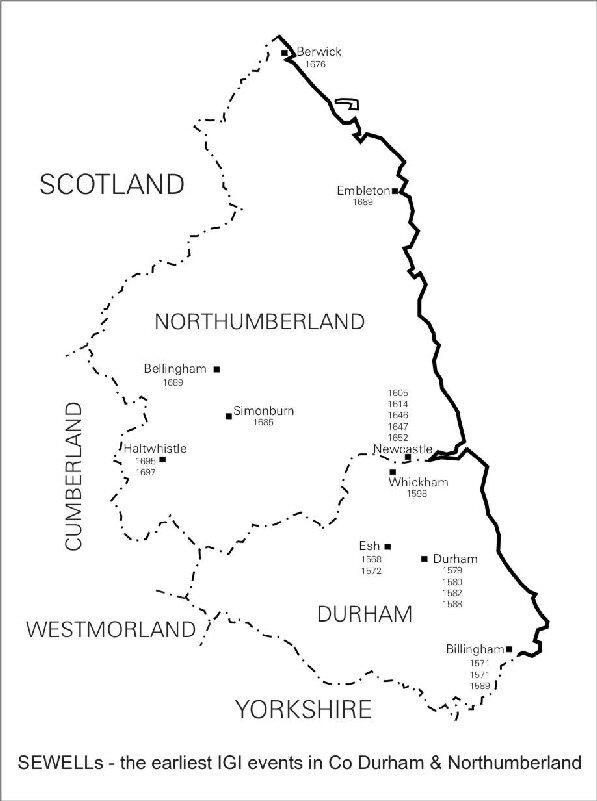
The appearance of ten 16th century SEWELLs amongst the IGI events in Co. Durham might suggest that the SEWELLs entered Northumberland from that direction. Documentary sources relating to County Durham have not so far revealed any pre-16th century references to SEWELL or its usual variants. Because Durham was a County Palatine it was exempt from taxation by the Crown, which means there are no Lay Subsidy or Poll Tax Returns to use as evidence.
In the absence of evidence to the contrary, it therefore seems likely that the SEWELLs may not have arrived in Northumberland until the early 17th century. If so where did they come from? Some will no doubt have arrived by sea, as the cluster of events in the coastal towns suggest. Those further inland are more likely to have come from Cumberland, which in the 16th century accounted for 6% of all the SEWELLs listed in the IGI. Having said this I have naturally become interested in finding out how the name took root in Cumbria.
Return to The Sole Society Home Page